
UK +44 131 560 6629 USA TOLL FREE 800-972-0408

UK +44 131 560 6629 USA TOLL FREE 800-972-0408

The River Tay ranks among Scotland's most famous Atlantic salmon fishing rivers, attracting anglers from around the world. As Scotland's longest river and largest by water volume, the Tay offers diverse fishing opportunities across some of Perthshire's finest scenery.
This updated guide for 2026 helps overseas visitors, particularly anglers travelling from the USA, plan their first River Tay salmon fishing trip. Whether you're an experienced salmon angler or new to Spey casting, the Tay offers opportunities for different abilities.
Moreover, the river's accessibility from Edinburgh makes it a practical choice for visitors combining salmon fishing with a Scottish holiday. Alba Game Fishing provides guided salmon fishing trips, including equipment, casting tuition and local knowledge of the river.
The River Tay stretches approximately 117 miles (188 kilometres) and drains a catchment covering around 2,500 square miles. Its headwaters rise on the western slopes of Ben Lui before flowing eastwards through the Scottish Highlands and Perthshire.
Eventually, the river reaches the North Sea through the Firth of Tay, near Dundee on Scotland's east coast.
Anglers often call the Tay the King of Scottish Salmon Rivers, reflecting its size, fishing heritage and reputation for Atlantic salmon.
Furthermore, the river offers a variety of fishing pools, from broad gravel-bottomed runs to deeper holding water. Consequently, anglers can experience traditional double-handed Spey casting alongside other permitted salmon fishing methods.
For international visitors, guided fishing provides practical access to the river, suitable equipment and advice on local fishing conditions.
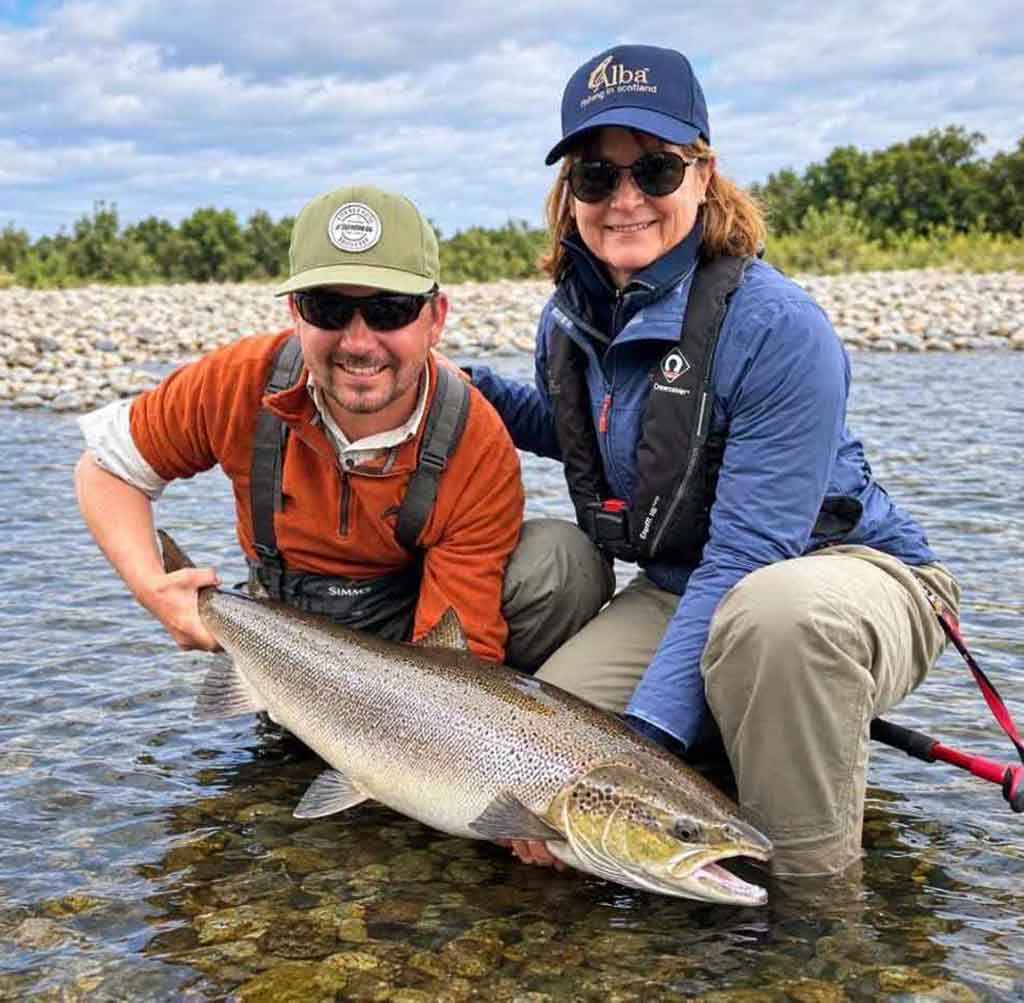
Planning a guided salmon fishing trip on Scotland's River Tay? These frequently asked questions cover fishing methods, equipment, safety, travel arrangements and what to expect during your day.
Yes, the River Tay offers excellent opportunities for beginners, including anglers with no previous salmon fishing or Spey casting experience.
Many of our guests have never used a double-handed salmon fly rod before. Your Alba Game Fishing guide will provide practical tuition throughout the day, helping you develop your casting technique and confidence.
Yes, most River Tay fishing beats permit spinning, although individual beat rules and seasonal restrictions may apply.
Our guides carry double-handed Spey rods and spinning equipment, allowing you to use the most suitable method for the conditions.
The River Tay is approximately one hour's drive from Edinburgh, depending on your chosen fishing beat and traffic conditions.
Most of the journey follows major roads, making the Tay a convenient destination for visitors staying in Edinburgh.

A River Tay ghillie manages a particular stretch of river, known as a fishing beat. Ghillies understand local water conditions, productive pools and the areas where salmon are most likely to hold.
However, a ghillie typically looks after several anglers and moves between them throughout the day.
Your Alba Game Fishing guide stays with you throughout your fishing experience, providing casting tuition, practical advice and assistance with wading.
Importantly, your guide and the beat ghillie work together, combining local river knowledge with dedicated personal guidance.
Many River Tay fishing pools have shallow gravel beds, making them suitable for anglers with varying levels of experience.
We generally avoid wading above knee height, and your guide will assess your mobility before selecting suitable fishing locations.
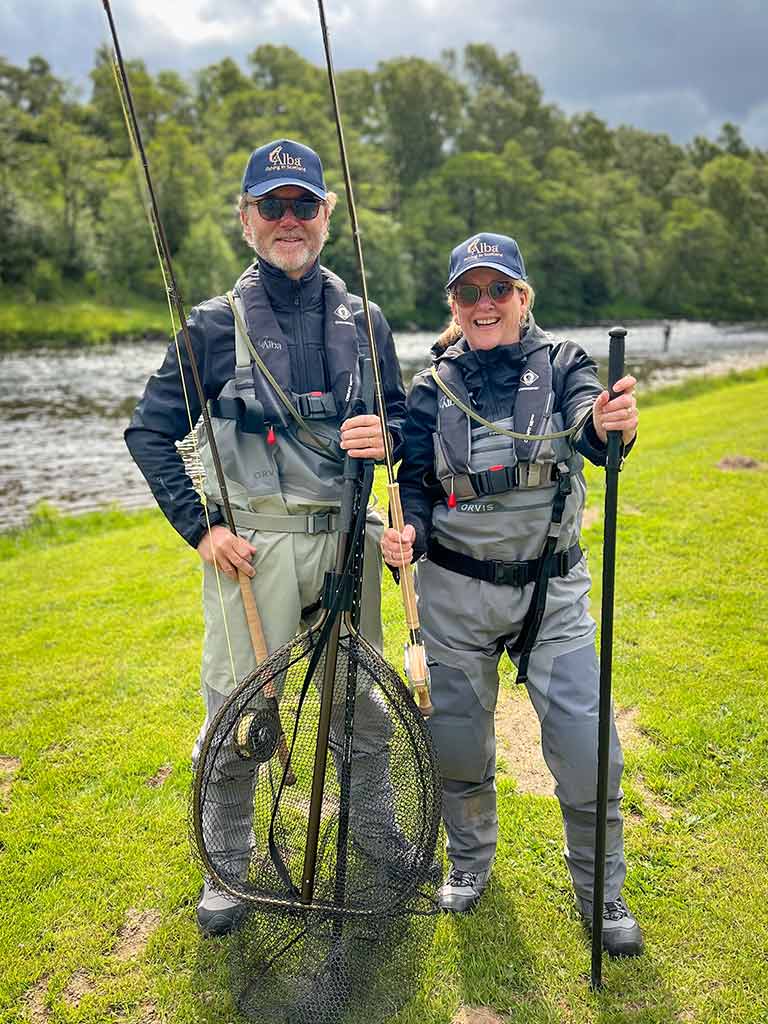
Additionally, we provide automatic inflatable lifejackets and wading sticks to help you maintain stability while fishing.
Yes, Alba Game Fishing supplies Orvis breathable chest waders and separate wading boots for our guests.
We carry a large selection of sizes, including boots up to US size 15.
Our wading boots feature tungsten studs, which provide additional grip on slippery riverbeds.
Before your trip, please submit your wader and boot sizes so we can prepare suitable equipment.
A typical salmon fishing day on the River Tay runs from 9:00 am until 5:00 pm, although we can offer some flexibility.
For guests travelling from Edinburgh, your guide normally arranges collection at approximately 8:00 am.
Depending on the fishing location and travel conditions, we generally return to Edinburgh around 5:30 pm. All that aside, we are flexible with timings, and if a different start finish time is required we will try to accommodate.
Lunch is not included in our standard guided salmon fishing trips.
However, we can arrange a catered riverside lunch through our local catering partner, Redwood Wines.
Please arrange this in advance so we can coordinate lunch with your fishing itinerary.
Dunkeld and Pitlochry are convenient locations for many of the River Tay salmon fishing beats we visit. Equally it's easily reached from the town of Perth.
All of these towns offer accommodation, restaurants and access to the surrounding Perthshire countryside.
The most convenient location will depend on your allocated fishing beat.

Atlantic salmon fishing is challenging, and even experienced anglers regularly finish a day without catching a fish.
Water levels, temperature, seasonal salmon runs and changing conditions all influence your chances of success.
Consequently, no responsible fishing guide can guarantee a salmon.
We recommend approaching a River Tay fishing trip much like steelhead fishing, where patience and persistence form part of the experience.
Above all, enjoy learning the techniques, exploring the river and experiencing Scotland's salmon fishing traditions.
Catching an Atlantic salmon is a memorable achievement, but it should never define the success of your day.
No. Alba Game Fishing operates a strict catch-and-release policy for all guided Atlantic salmon fishing trips.
Your guide will help you handle the fish carefully, take photographs where conditions allow and release it safely.
This approach supports the conservation of wild Atlantic salmon populations.
Alba Game Fishing requires one guide for every two anglers.
Therefore, groups of three or four anglers need two guides, while groups of five or six require three.
This arrangement allows us to maintain appropriate supervision, provide individual tuition and meet our safety and insurance requirements.
Yes, you can bring your own fishing rods, reels, lines, waders and other equipment.
However, you must clean and disinfect equipment that has previously contacted freshwater before bringing it to Scotland.
These precautions help prevent the introduction of invasive organisms and parasites, including Gyrodactylus salaris, which poses a serious threat to Atlantic salmon.
Please contact Alba Game Fishing before travelling so we can explain the relevant biosecurity procedures and current requirements.
Alternatively, we can supply the fishing equipment you need for your day.

Yes, non-angling partners, friends and family members are welcome to accompany our fishing guests.
Many River Tay beats offer attractive riverside walks and comfortable fishing huts where visitors can relax.
Some huts also feature log-burning stoves, providing a warm place to enjoy tea, coffee or lunch.
Facilities vary between fishing beats, so please tell us in advance if anyone in your group does not intend to fish.

First of all it's a pleasant 1 hour drive from the West end of Edinburgh. Along the way, you'll pass Loch Leven, this is one of the world's most famous trout lochs. For the main part, it's all motorway to the village of Dunkeld. Furthermore, our guides can sometimes pick you up from an Edinburgh hotel.
For those wanting to make their own way to the Tay, there is an excellent train service. In addition Dunkeld is also a good stop en route to traveling North to Inverness and the Highlands.

To begin with, non anglers are 100% welcome to come and enjoy the great scenery, and beauty of this Scottish river. Also there are excellent river side paths. If fishing near Dunkeld, Shakespeare lovers can walk from the beat hut to the Birnam Oak.

As well as the walks, and interesting sights, there are excellent fishing huts, that cater for non anglers. You can relax, enjoy a tea or coffee and put your feet up by the fire. Equally the village of Dunkeld is a short distance away and is an interesting village to visit.
First and foremost, the Tay is regarded as Scotland's most accessible and fishable salmon rivers, thanks to its vast size. The Tay has consistent water levels, and numerous tributaries. Equally the river is suitable for both beginners and experts alike.
Furthermore, its numerous lochs help regulate water levels, ensuring that the river remains fishable even during the lowest summer flows. Similarly, the Tay remains accessible even after heavy rainfall. This is because these lochs act as natural settling tanks that reduce floodwater sedimentation. On numerous occasions, and in low water, the Tay will remain fishable, and this is important for our guests who travel from the US.

In addition to its impressive size, the River Tay is also incredibly convenient for anglers visiting Scotland. Thanks to its proximity to Glasgow and Edinburgh, both just 90 minutes by car, the river is easy to reach for American visitors. Beyond fishing, the Tay offers a full Scottish experience, combining world-class salmon fishing with the charm of Scotland’s beautiful landscapes and historic towns.
It is no secret that the River Tay is renowned for its big fish, with its long history of producing some of the largest salmon in the country. For example, in 1922, a remarkable 64-pound salmon was caught in the Tay’s famous Glendelvine Beat by Georgina Ballantine. In fact this still stands as the largest rod-caught salmon in British history. More recently, anglers have landed fish in the 40-pound range proving that the Tay still has room for giants.

What’s more, many believe that salmon even larger than 50 pounds still make their way up the River Tay each year, particularly during Autumn. Although these massive fish are often found dead as "kelts" it's a reminder of the potential for truly legendary catches in the Tay.
When it comes to timing your fishing trip, the River Tay offers excellent fishing opportunities throughout its extended season. The River Tay fishing season officially opens on January 15th, with fresh run salmon appearing early in the season and remaining present through February. However, March is when the magic truly begins, as the arrival of warmer weather triggers a greater influx of salmon. As the river warms, fish begin migrating into Loch Tay and its tributaries, including the Isla and River Tummel rivers.
By April and May, conditions are ideal for catching fresh Spring salmon, with March through May typically being the prime time for larger fish. Subsequently by June and July, the river often reaches its lowest levels, and sparsely dressed traditional flies like the "Silver Stoat" and "Blue Charm" prove especially effective in attracting fish. Furthermore, summer marks the arrival of Grilse These are salmon that have spent one winter at sea and average between 4 and 9 lb in weight.

As August and September approach, the river sees an influx of autumn salmon, with larger fish becoming more prevalent.
Finally for those fishing into October, the River Tay’s Autumn runs and big fish, with the cooler waters providing ideal conditions for salmon fishing.
To ensure a successful and enjoyable fishing experience, it’s important to have the right equipment for the River Tay’s varying conditions. Here’s a list of essential fishing gear you'll need for the River Tay:
Undoubtedly, the River Tay is known for its array of salmon flies, each suited to different seasons. Here are some of the most popular patterns used by successful anglers:


Without doubt, you should dress appropriately for a day on the river. Especially when wading.
Even in the summer, wear layers, that can be removed or layered up as the temperature changes. The weather on the River Tay is unpredictable, and conditions can go south very quickly, so be prepared.
When wading, wear two layers on your legs and thick socks. Equally, try to avoid clothing with zips, buckles and as these are downright uncomfortable under waders. Bring a warm hat and we will supply you with a cool "Fishing in Scotland" baseball cap. Patagonia base layers and lightweight thermal jackets are excellent.

Summary of what to bring for your salmon fishing day:
1. Sunglasses - this is Vitaly important for eye protection
2. Warm layers. Its also best not to wear jean under waders, soft joggers or thermal leggings are best, free from buckles, studs and zips
3. Waterproof rain jacket
4. Sensible footwear for when not wading (some fishing can be from the bank) wet grass with a good grip on the sole, i.e. walking boots or gore tex trainers
5 Lunch and drinks
While fishing the River Tay is a highlight of your trip, the surrounding area offers much more. The River Tay flows through picturesque towns such as Aberfeldy, Pitlochry, Dunkeld, with Perth being the main city where the river meets the North Sea. These towns offer a variety of accommodations, from charming B&Bs to high-end hotels, all within easy reach of the river’s best fishing beats.

Undoubtedly, Dunkeld is one of our favourite towns, not just on the Tay but in Scotland. A small village with a great community. There's an 11th century cathedral, artesan shops, and great places to eat. Redwood wines is one of the best restaurants in Perthshire. There's an award wining bakery and unique art galleries. The gallery in Dunkeld its on e of the few to stick original David Henty paintings. This beautiful town is right on the banks of the Tay. Not to be missed are the Taybank folk music pub and outside eating and local ales by the river.
Furthermore, if you're looking for great accommodation in Dunkeld, the Atholl Arms is a great choice. It has been recently refurbished and sits overlooking the Telford bridge of the River Tay. Importantly you can walk to all the pubs and restaurants from here with ease.
In recent years, the River Tay management has made significant strides to protect the river’s salmon population. Through Catch & Release measures, these efforts have helped ensure that salmon runs remain strong and sustainable. Additionally, the Scottish Government has implemented a policy making it illegal to kill wild salmon until April 1st each year,. Therefore providing further protection to the river’s valuable fish stocks.
Thanks to these conservation practices, the Tay has seen encouraging salmon runs, ensuring that future generations of anglers can continue to experience the thrill of fishing here.
The River Tay offers several fishing methods to suit various preferences. Fly fishing and spey casting are the most traditional and popular technique, using a 14-16ft double-handed rod. Alternatively, spinning with a 9-11ft spin fishing rod is ideal for those who prefer a more hands-on approach. Another unique method is harling (boat fishing), which involves trolling with multiple rods from a boat to cover a wider area.

Equally a professional guide will advise on the best fishing approach based on the prevailing water conditions. Sometimes, deploying multiple methods throughout the day is the most effective way to catch salmon. This also ensures a varied and interesting experience, as you can mix spin casting with fly fishing.

If you’re new to salmon fishing or want to refine techniques, you should consider booking a professional River Tay fishing guide. A guide will supply all the necessary equipment and expert advice to help you land your first Scottish salmon.
Furthermore it's vital to book your salmon fishing day well in advance. It's late December 2024 when I wrote this and we are already 60% booked for next season.

For over a thousand years, Salmon fishing has played a significant role in Tayside and Scotland. Initially, salmon were carved on stones by a Pictish craftsman at Meigle, near the River Isla. In fact throughout Scotland and particularly in the North East, the Salmon was a common Pictish symbol.

By 500 years ago, salmon had become an essential part of international trade, with the Tay involved in the export of salted fish to Europe.
In 1786 salmon packed in ice proved to be a game changer, boosting the market for Tay salmon. Consequently, ice houses were built to store the ice collected during winter.

Netting salmon on the lower river was common practice. As a result, this limited the fishing in the upper river. At Pitlochry's falls, wicker baskets were used to catch jumping salmon. In fact, spearfishing became popular by the 19th century, especially during spawning time.
In the 20th century, the lower river had a large commercial salmon netting operation. However the net fishing on the Tay ceased in 1996, following a buyout scheme by the Tay Foundation. Naturally this greatly improved the fishing for sporting anglers on the river.
Lastly, by the late 20th century, angling became the primary method for catching salmon in the Tay, contributing significantly to the local economy. Therefore Today, fly fishing for salmon remains one of the top 5 attractions when visiting Scotland.

In conclusion, for American anglers, fishing the River Tay is more than just a fishing trip. In fact it’s a journey to one of the world’s most iconic salmon rivers. From its legendary fish to its stunning landscapes and rich history, the Tay offers an experience unlike any other. It matters not if you’re chasing a monster salmon or simply soaking in the beauty of Scotland. The River Tay will undoubtedly leave you with memories to last a lifetime.
Finally follow this link to book River Tay salmon fishing trip today, we look forward to giving you a warm welcome.